What Happens to Your Jaw the Longer You Wear Dentures
Reviewed by Dr. Steven Schadinger - MSc, DMD
Most patients are told how an extraction will heal. Very few are told what happens to the jaw in the years afterwards.
Once teeth are gone, the bone that held them begins to shrink. The process is called residual ridge resorption. It is fastest in the first year, it never entirely stops, and it determines which treatments are still open to you a decade later, including whether you are a candidate for implant-supported dentures.
This article explains how that bone loss works, how quickly it happens, why the lower jaw is affected far more severely than the upper, and what it means for your options, from dentures and broader restorative dentistry through to the bite changes and TMJ strain that can follow. It is written for two people: anyone already in dentures who is finding the fit gets worse with every reline, and anyone facing tooth loss who wants to understand what waiting actually costs.
Article Takeaways
A denture rests on bone that is still shrinking underneath it, which is why a plate that fit well two years ago now needs adhesive to get through a meal.
The lower jaw loses bone up to four times faster than the upper, which is why the lower denture is almost always the one that will not stay put.
The front of the lower jaw is the last place to lose bone, so most long-term denture wearers are still candidates for implant-supported dentures.
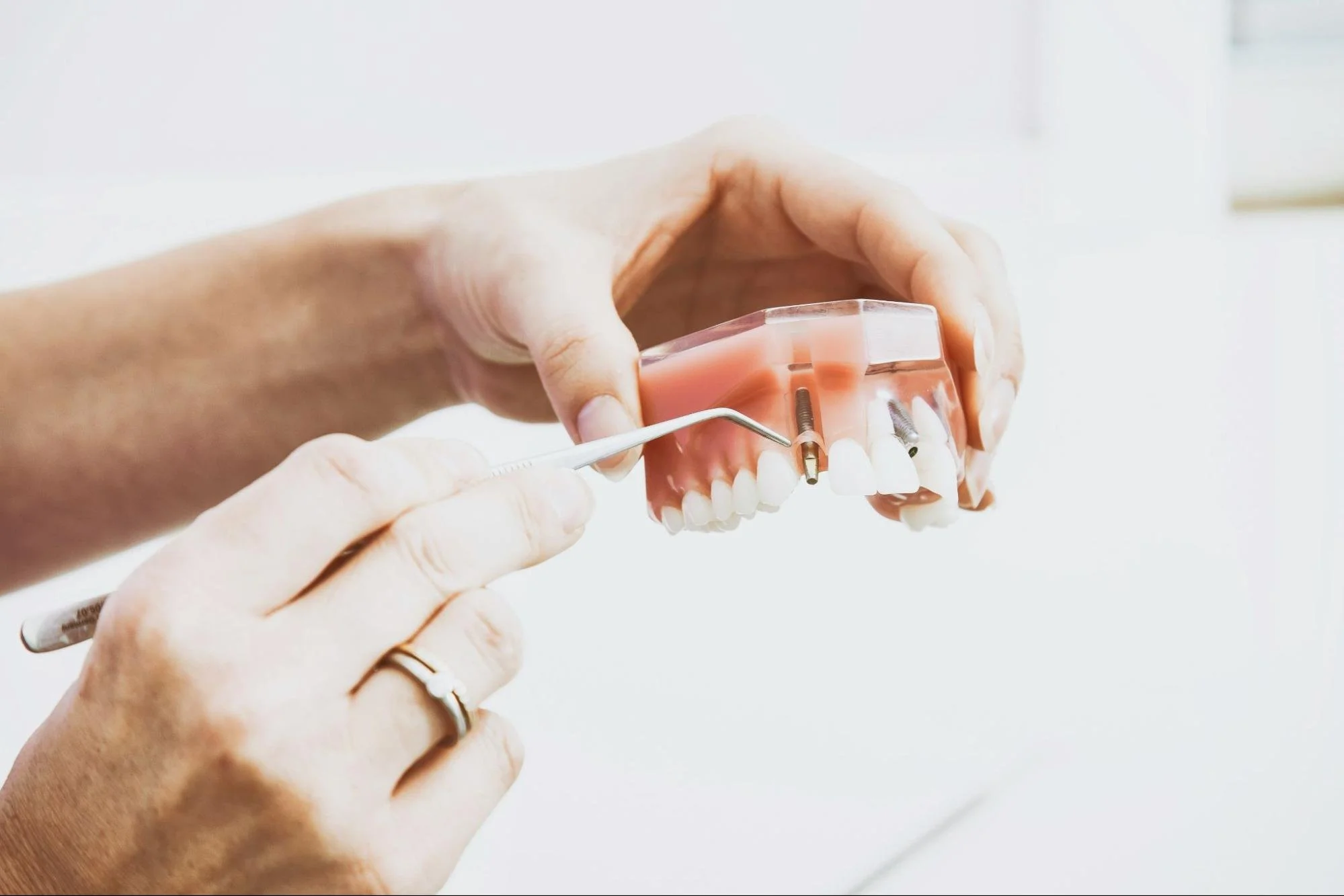
The bone under your denture was built for teeth you no longer have
The ridge your denture sits on is not general-purpose jawbone. It is a specialised structure called the alveolar ridge, and it exists for one purpose, which is to anchor tooth roots.
Once those roots are removed, the body no longer registers a functional demand on that bone and begins reabsorbing it. This starts within days of an extraction and continues, at a slowing but persistent rate, for the rest of your life. Your denture was fitted to the shape of that ridge on one particular day. The ridge has been changing ever since.
How fast bone loss happens, and where you are in it
If you are about to lose a tooth, the next three months matter more than the next ten years. If you lost your teeth decades ago, the change is slower now, but it has not stopped.
Most of the bone goes early. A 12-month study of healing extraction sites found the ridge lost about half its width within the first year, and two thirds of that happened in the first three months. A systematic review of post-extraction sockets put a typical healed site at 3.87 mm of width and 1.67 mm of height gone.
Those are small numbers on paper. On a ridge that a denture has to grip, a few millimetres changes how the whole thing sits.
After the first year the rate drops off sharply, and this is where people assume it has finished. It has not. Tallgren's 25-year study of denture wearers followed patients for two and a half decades and found them still losing measurable ridge height at the end of it.
So if your denture has been getting less reliable for years with nothing obvious to blame, that is the explanation. The denture has not changed. The floor it sits on has been moving the whole time.
Why your lower denture is the one that will not stay put
You already know which one is the problem. The upper plate mostly behaves. The lower one lifts when you laugh, shifts when you chew on the wrong side, and takes more adhesive every year to get through a meal that used to be no trouble.
That is not bad luck, and it is almost never a badly made denture. Your lower denture is doing a harder job than your upper one, on worse ground, and it is losing.
Start with the ground. The lower jaw loses ridge at about twice the rate of the upper in the first year, and by around seven years without teeth that gap has widened to roughly four to one. Whatever is happening under your upper plate, considerably more of it is happening underneath the lower.
An upper denture covers the roof of your mouth and seals against it, and that seal is most of what holds it up. A lower denture gets no seal at all. It is a horseshoe balanced on a shrinking ridge with your tongue moving through the middle of it, and it has a little over half the surface area to spread every bite across, 2.3 square inches against 4.2.
Half the footprint, no suction, and the ridge underneath is the one going fastest.
And it keeps going. More pressure means the bone goes faster, less bone means it fits worse, and a worse fit means more pressure again. That's why it feels like it went downhill fast after years of being fine. Nothing changed overnight. You just hit the point where you started noticing it.
The good news is the bottom is also where the smallest fix works. Most people assume implants means a whole mouth of them. For a lower denture it's usually two.
Why relines only buy time
A reline reshapes the fitting surface of your denture to match the ridge as it is today. It is a sensible, routine procedure and it genuinely helps.
What it cannot do is address why the fit changed. The denture is being adjusted to a moving target. This is why relines tend to buy progressively less time than the one before, and why patients often describe a denture as having been "fine for years" and then deteriorating quickly. Nothing sudden happened: The ridge crossed a threshold where the shape could no longer be compensated for.
If your relines are coming closer together, that is useful information rather than a nuisance. It is a reasonable point at which to ask what the bone underneath actually looks like.
What you notice, and what you tend to blame it on
Ridge resorption rarely announces itself. It arrives as a series of small changes that are easy to explain away:
A denture that fit well for years and now needs adhesive to get through a meal
Relines that buy less time than the last one did
Sore spots that move around instead of settling
A change in the face, with the lower third shortening and the chin coming forward slightly
Deepening lines at the corners of the mouth
The facial changes usually get put down to ageing. Some of that is fair. A good part of it is structural. As ridge height goes, the vertical distance between nose and chin shortens. The soft tissue draped over that structure has nowhere to go.
The upper front is where this shows most. Where several teeth were removed at once, height and width loss in that area can reach as much as 70 per cent. That same loss of height also changes how your upper and lower jaws meet.
Sustained over years, an altered bite can place extra strain on the jaw muscles and the temporomandibular joint. If you have noticed jaw fatigue, clicking or headaches alongside a denture that no longer fits, it is worth raising both at the same appointment. They may be connected.
The part that works in your favour
There is some good news here, and it rarely gets said.
Bone does not disappear evenly across the jaw. Some areas go quickly, others hold on, and the area that matters most for treatment happens to be the most durable one you have.
That area is the front section of the lower jaw, between the two mental nerves. It resorbs about four times more slowly than the back of the lower jaw, and it is the last part of the mandible to go.
It is also exactly where implants for a lower overdenture are placed.
So the assumption that stops most long-term denture wearers from asking, that fifteen or twenty years must surely have put treatment out of reach, is usually wrong. The bone you need is the bone your body holds on to longest.
What this means if you are considering implant-supported dentures
An implant is a titanium post that needs enough living bone around it to lock into and stay locked into. Bone is the raw material, and everything downstream depends on how much there is and where it sits.
With enough bone, the path is straightforward. With less, options narrow to shorter or narrower implants, angled placement to reach bone that is still there, or grafting to rebuild what has gone. Grafting is routine and it works well, but it adds cost, it adds a healing phase of several months before implants can be placed, and it adds appointments. If you are driving in from Golden or Sicamous in February, appointments are not a trivial cost.
This is the sober version of "do not leave it." Not that a window is about to slam shut, but that the same outcome is generally simpler, cheaper and faster the earlier it is done.
You cannot assess any of this by looking, and a standard two-dimensional x-ray shows height reasonably well but tells you very little about width, which is frequently the limiting dimension. Proper assessment takes 3D imaging, which shows the ridge in cross-section: how wide it is at the crest, where the nerve canal runs, and whether an implant of a given diameter will fit where it needs to go.
Selkirk Dental uses 3D imaging to plan implant placement before any surgical decision is made.
Selkirk Dental places dental implants in-house, including bone grafting where there is not enough bone to work with, and provides implant-supported dentures including All-on-4 and All-on-6 full-arch options.
Why Implants Slow Bone Loss When Dentures Cannot
Bone maintains itself in response to load. Take the load away and the body reabsorbs it. That is the mechanism driving ridge resorption in the first place.
The difference between a denture and an implant comes down to where the force goes.
A conventional denture sits on the gum and presses down on the surface of the ridge. That surface pressure does nothing to preserve the bone underneath, and as the bearing-pressure figures above suggest, it may well be speeding the loss up.
An implant is anchored inside the bone and transmits force through it. That is the signal bone responds to, and it responds by staying put.
This difference is established well enough to have shaped professional guidance. The McGill Consensus Statement of 2002 and the York Consensus Statement of 2009 both concluded that a two-implant lower overdenture should be the minimum first-choice treatment offered to patients with no lower teeth. York stated it directly: the rate of bone loss in edentulous jaws is greatly reduced once implants are placed. It also recorded significantly better chewing efficiency and higher patient satisfaction.
Note the number. Two implants, not four or eight. For a lower denture that will not stay put, the established starting point is a much smaller intervention than most people expect.
If you have worn dentures for years already
You have lost bone, and nobody can give you the last twenty years back. The front of your lower jaw has very likely held up better than you fear. Grafting can rebuild a meaningful amount of what has gone. And the practical question was never whether your jaw is perfect. It is whether there is enough bone in the right place, and if not, whether it can be built.
That question has a real answer, and the answer comes from imaging rather than from guessing or assuming the worst.
Questions worth asking at a consultation
How much bone do I have, and where is it thinnest?
Am I a candidate now, or would I need grafting first?
If grafting is needed, how many months does that add before implants can go in?
Would two implants be enough in my case, or is there a specific reason I would need more?
How many separate trips will this take, and can any of them be combined?
What does maintenance look like afterwards, and how often?
Common questions
Does wearing a denture cause bone loss?
Wearing a denture does not cause bone loss, but it does not prevent it either. The loss is set off by losing the teeth themselves. A conventional denture rests on top of the ridge and presses on its surface rather than transmitting force through the bone, so it never supplies the loading that keeps bone maintained.
How fast does the jaw shrink after tooth loss?
The jaw shrinks fastest in the first year after tooth loss, when roughly half the width of the ridge disappears, and most of that happens within the first three months. The rate slows considerably after that, but it never stops entirely and continues for the rest of your life.
Why does my lower denture move when my upper one does not?
Your lower denture moves while the upper one stays put because the lower jaw loses bone up to four times faster, and a lower denture has far less area to grip. Its bearing surface measures about 2.3 square inches against 4.2 for the upper, which nearly doubles the pressure on the ridge underneath. Both factors work against you at once.
Is it too late for implant-supported dentures if I have worn dentures for twenty years?
It is usually not too late for implant-supported dentures, even after twenty years without teeth. The front of the lower jaw is the most resorption-resistant area in the mouth, and it is exactly where overdenture implants are placed. Imaging is the only way to know for certain in your own case.
Can lost jawbone be rebuilt?
Lost jawbone can be rebuilt, through a well established and predictable procedure called bone grafting. The trade-off is time, since grafting adds a healing period of several months before implants can be placed.
Do implant-supported dentures stop bone loss completely?
Implant-supported dentures do not stop bone loss completely, but they substantially reduce it in the area around the implants. That is the area that determines whether the restoration stays stable over the long term.
About Selkirk Dental
Selkirk Dental Clinic provides implant-supported dentures alongside complete, partial and immediate dentures, as well as relines and repairs.
The clinic sees patients from across the Highway 1 corridor and the Columbia and Slocan valleys, including Sicamous, Malakwa, Golden, Field, Lake Louise, Nakusp, New Denver, Slocan, Winlaw, Fauquier, Burton and Trout Lake.