Dental Sedation Available Between Salmon Arm and Lake Louise
Reviewed by Dr. Steven Schadinger - MSc, DMD
If you live in Revelstoke, Sicamous, Golden, Nakusp, Field or Lake Louise, you already know that dental care in the mountains works differently than it does in a city. The clinic list is short. The drive can be long. And if the thought of a dental chair makes your stomach drop, the whole thing can be easy to put off for another year.
Sedation can take the anxiety out of your dental visit.
This guide walks through what sedation feels like, how long it lasts, whether you can drive yourself home after your dental appointment, and what training and provincial registration British Columbia requires of the dentist administering it. We also map which offerings for sedation are available in each community along this corridor, including the ones we cannot offer and the towns where somebody closer to you is the better call.
This blog is written by the Selkirk Dental team in Revelstoke, a dental clinic offering full sedation dentistry services.
Article Takeaways
Sedation lets your dentist do more work in a single visit, which matters when every appointment means a mountain drive.
Dental sedation is a ladder of four distinct options, from laughing gas you can drive home after to full general anesthetic in a hospital, and each rung fits a different patient and procedure.
BC law sets sharply different training and registration requirements for each level of sedation, and patients are entitled to ask any dentist which registration they hold.

Why Sedation Matters More in the Mountains
In a city, sedation is mostly about comfort. Out here it is also about logistics.
A patient in Vancouver who needs four fillings, an extraction and a crown can book six short appointments over three months without much thought. A patient driving in from Sicamous is looking at six round trips totalling roughly twelve hours in the car, and if it is February, six trips over a mountain pass in whatever the weather is doing that morning.
Under deeper sedation, a dentist can often complete in one long appointment what would otherwise take four or five short ones, depending on the treatment involved and your medical history. For patients who travel to reach us at Selkirk Dental in Revelstoke, that is frequently the single biggest practical benefit.
It also matters because avoidance compounds. Dental anxiety is not a character flaw. It is a well-documented clinical phenomenon that affects roughly one in five people, and it has a predictable trajectory. A small problem deferred becomes a moderate problem, which becomes an urgent one, and urgent dental problems in a small mountain town, on a Sunday, are genuinely difficult to solve. Sedation is often what breaks that cycle.
The Four Rungs of the Sedation Ladder
Dental sedation in Canada is classified by how deeply your consciousness is affected, not by which drug is used or how it gets into your body. That distinction matters, and we will come back to it, because it is the basis of how the province regulates who may do what.
Rung 1: Nitrous Oxide (Laughing Gas)
Nitrous oxide is the gentlest rung on the ladder and, for most people, the easiest introduction to sedation. You breathe a blend of nitrous oxide and oxygen through a small mask that sits over your nose. You stay fully awake and able to talk to your dentist throughout.
Most patients describe it as a light, warm, slightly floaty feeling, a sense that the appointment is happening at a comfortable distance rather than right on top of you. Some people feel a mild tingling in their hands and feet. It does not put you to sleep, and while nitrous does dull your sensitivity to pain, it does not eliminate it. You will still be frozen with local anesthetic for anything that requires it.
What makes nitrous distinctive
It works within minutes. Effects begin about three to five minutes after you start breathing it, and the dentist can adjust the concentration up or down during the appointment as needed.
It clears almost as fast. Once the mask comes off and you breathe pure oxygen for a few minutes, the effects fade quickly, typically within about 15 to 30 minutes. For patients who travel in for appointments, this is the property that matters most.
You can usually drive yourself home. This is the crucial practical difference between nitrous and every other rung on this ladder. Because it clears so quickly and completely, most patients are cleared to drive after a short recovery period. For someone travelling in alone from Sicamous or Malakwa with nobody available to drive them back, nitrous is often the only sedation option that fits the day.
It is well suited to children. Nitrous is widely used in pediatric dentistry precisely because it is mild, adjustable and fast to reverse.
Where nitrous falls short
Nitrous takes the edge off. For a patient with mild to moderate anxiety facing a filling or a cleaning, that is usually enough. For someone with genuine dental phobia, or for a long surgical appointment, it generally is not. The anxiety relief is real but limited, and it does nothing to compress a five-appointment treatment plan into one visit. It is also unsuitable for patients with certain respiratory conditions or a blocked nose, for the simple reason that you have to be able to breathe through your nose for it to work at all.
Nitrous at Selkirk Dental
We offer nitrous oxide at our Revelstoke clinic, for adults and for children.
It is billed separately from the treatment itself, at roughly $80 per 15 minutes, so what you pay depends on how long you are in the chair. Ask us for an estimate when you book and we will give you one.
Medical reasons to rule a patient out are rare, and we have not yet had to turn anyone away on those grounds. The far more common obstacle is much simpler: a blocked nose. The gas is delivered through a nasal mask, so if you arrive with a heavy cold we will likely suggest either rescheduling or going ahead without it. We review your medical history before any sedation in any case.
Rung 2: Oral Sedation
Oral sedation means taking a prescribed sedative medication, usually a tablet, typically about an hour before your appointment. It is one of the most common forms of dental sedation in Canada and, for most anxious patients, the first genuinely powerful option on the ladder.
The experience is different from nitrous in kind, not just in degree, and it varies considerably depending on the dose. At the lighter end, you remain fully conscious and alert but noticeably calmer, with the edge taken off. At the deeper end, you feel profoundly relaxed and detached from what is happening, and many patients doze lightly and are easily roused.
The two tiers of oral sedation
This is where a distinction appears that most clinic websites skip over entirely, and it is worth understanding because it determines what your dentist is legally permitted to do.
A single sedative tablet, taken within the maximum recommended dose, is classified as minimal sedation. A dentist may provide it without any special provincial registration.
Multiple oral sedatives, or a single drug pushed beyond the maximum recommended dose, cross the line into moderate sedation. In British Columbia, that requires the dentist to hold a specific registration with the provincial regulator, granted only after documented additional training and supervised clinical experience. We cover the exact requirements further down, because we think patients should be able to check.
What oral sedation asks of you
You cannot drive. Not to the appointment, not home from it, and not for the rest of that day. You must arrange a driver, and for patients travelling in from out of town, this is the single most important thing to plan around.
The medication takes time to work and time to wear off. Expect to arrive early, and expect grogginess to linger for several hours afterwards. Plan a quiet evening.
You will need to follow fasting and medication instructions. We will give you specific guidance in advance, and it is important to follow it exactly.
Someone should stay with you. For the first several hours after you get home, you should not be on your own.
Oral sedation at Selkirk Dental
We provide single-drug oral sedation, on its own or combined with nitrous oxide. We do not use multiple oral sedatives. Under the provincial rules set out below, that puts what we offer in the minimal sedation tier.
There is no clinic fee for the sedation itself. We write the prescription, you collect it from the pharmacy and take it an hour before your appointment, so the only cost is whatever the pharmacy charges for the medication.
We do ask for a deposit on treatment booked under sedation. The reason is that we cannot ask someone to settle an account while they are still sedated, so it is handled beforehand instead. The driver is not negotiable. No escort, no treatment. If you arrive without someone to take you home we will have to rebook you.
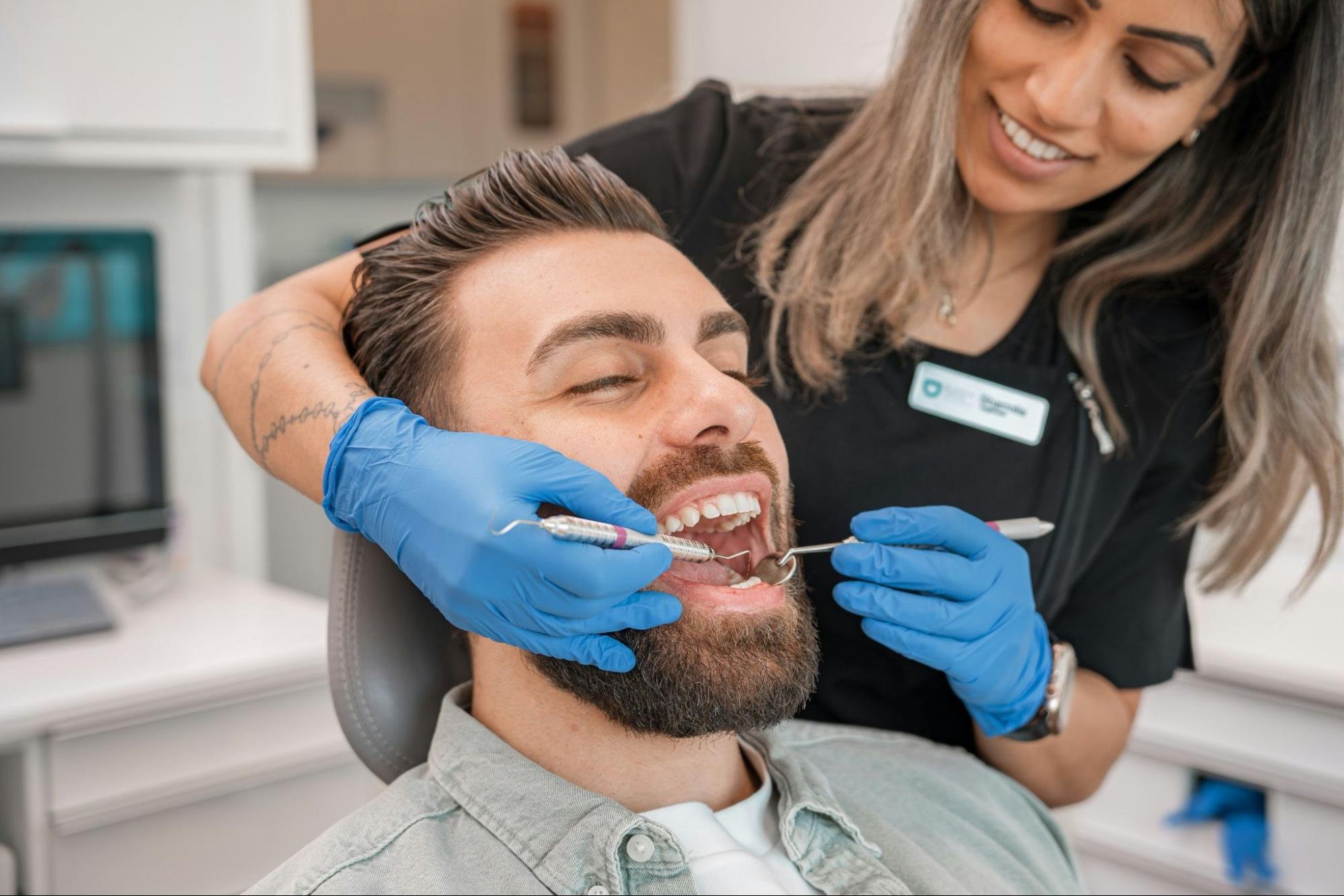
Rung 3: IV Sedation
Intravenous sedation delivers the medication directly into a vein through a small cannula, usually in the arm or the back of the hand. Because it bypasses the digestive system entirely, it works within moments and, critically, the dentist can adjust the depth of sedation continuously throughout the appointment rather than being committed to whatever a tablet does.
Patients under IV sedation are typically in a state often described as twilight sleep: conscious enough to respond if spoken to, but profoundly relaxed and usually with little or no memory of the procedure afterwards. It is the standard choice for lengthy surgical work, complex extractions, multiple implants, and for patients whose anxiety has not responded to gentler options.
IV sedation is also the rung where the regulatory bar rises sharply, and where the number of clinics able to offer it drops off a cliff, particularly outside of cities.
IV sedation at Selkirk Dental
We provide IV sedation in-house at our Revelstoke clinic. Dr. Steven Schadinger, MSc, DMD, holds the provincial registration for it personally, granted in 2024, covering single-drug IV sedation to a moderate level.
iV sedation bills at roughly $800 per hour, so what you pay depends on how long the appointment runs. Work that would otherwise be split across four or five visits can often be done in one, which for anyone driving in over the pass is four or five drives saved along with it.
The wait for procedures using IV sedation is usually one to two weeks.
Rung 4: General Anesthetic
General anesthetic is the top of the ladder. You are fully unconscious, you have no awareness of the procedure at all, and your breathing and vital signs are monitored continuously by an anesthesia provider throughout. In dentistry it is normally delivered in a hospital operating room or a specially registered and inspected facility, not in an ordinary treatment room.
It is reserved for situations where nothing below it will do the job: very extensive surgical treatment, patients with severe dental phobia that has not responded to other approaches, patients with certain medical or developmental conditions that make conscious treatment unsafe or impossible, and young children needing extensive work.
On that last point, there is a provincial rule worth knowing about if you have kids. In British Columbia, moderate sedation may only be given to patients aged twelve and under in a non-hospital dental facility by a dentist who is separately qualified in deep sedation or general anesthesia, or who has completed a formal postgraduate program in pediatric dentistry. This is why clinics across this region route children needing significant treatment to a hospital setting rather than sedating them in the office. It is not caution, it is regulation.
General anesthetic at Selkirk Dental
We do not provide general anesthetic or deep sedation in the clinic itself. Both take place at Queen Victoria Hospital here in Revelstoke, with a GP anesthetist supervising throughout, and Dr. Schadinger carrying out the dental treatment.
The anesthetic is billed under MSP, so it is covered by health insurance.
The wait for treatment with this level of anesthetic can be months, this due to the wait for a hospital operating room, and it is the main reason we will suggest IV sedation instead wherever IV will do the job.
For children, this is routine here rather than unusual. Dr. Schadinger treats three to five children a month at Queen Victoria Hospital for restorative or surgical work. So if your child needs significant treatment and you have been told it has to happen in a hospital, Selkirk Dental can be brought in for the dental treatment.
Four Sedation Methods Available From Dentists
| Nitrous Oxide | Oral Sedation | IV Sedation | General Anesthetic | |
|---|---|---|---|---|
| Awareness | Fully awake | Awake but detached; often drowsy | Twilight, rousable | Fully unconscious |
| Memory of visit | Usually full | Patchy or none | Usually none | None |
| Onset | 3 to 5 minutes | About 1 hour | Almost immediate | Immediate |
| Wears off | Minutes | Several hours | Hours; full day to clear | Hours; monitored recovery |
| Drive yourself home? | Usually yes | No | No | No |
| Best for | Mild anxiety; routine work; kids | Moderate to high anxiety; longer visits | Severe anxiety; surgery; multiple procedures in one visit | Extensive surgery; severe phobia; young children; medical complexity |
| Sedation class | Minimal | Minimal or moderate, depending on dose | Moderate | General anesthesia |
| BC registration required? | No | No if single drug within MRD; yes if moderate | Yes | Yes, plus registered facility |
| Offered at Selkirk Dental | Yes | Yes | Yes, IV single drug | Yes. Deep sedation and GA at the hospital |
Who Is Actually Allowed to Sedate You in British Columbia?
This is the section we most want you to read, and it is the one you will not find on other clinic websites.
Sedation is not a service a dentist can simply decide to start offering. In British Columbia it is governed by the BC College of Oral Health Professionals, which sets out exactly how much training each rung of the ladder requires, which certifications the dental team must hold, and which levels demand formal registration and prior approval before a single patient is treated.
Here is what the province actually requires:
Minimal sedation: no registration required
Nitrous oxide and oxygen alone: a minimum of 14 combined hours of didactic and clinical training, plus current Basic Life Support certification for healthcare providers. No registration with the College is required.
A single oral sedative within the maximum recommended dose: training through an undergraduate or postgraduate course, plus current BLS certification for healthcare providers. Again, no registration required.
Nitrous combined with a single oral sedative: a minimum of 16 combined hours of training. Still no registration required.
Moderate sedation: registration and prior approval required
Multiple oral sedatives: 40 hours of didactic instruction plus supervised sedation on 20 adult patients, concurrent with dental treatment, or the equivalent 20 cases completed through a formal mentorship. Requires current Advanced Cardiac Life Support certification, and the dentist must be registered with and approved by the College before providing this.
IV sedation, Level 1 (benzodiazepines): a minimum of 60 hours of didactic instruction plus 20 supervised cases in which the dentist personally places the IV, administers the sedation and carries out the dental treatment at the same time. Requires current Advanced Cardiac Life Support certification, and requires College registration with documented proof.
IV sedation, Level 2 (benzodiazepines plus narcotics): Level 1 registration first, plus a documented history of 150 moderate IV cases within the previous three years, plus a further 20 supervised cases using the combination. Registration required.
Treating children: any dentist providing moderate sedation to a patient aged twelve or under must additionally hold current Pediatric Advanced Life Support certification.
Ongoing education: every dentist registered for moderate sedation must complete at least six hours of sedation or anesthesia continuing education in each three-year cycle.
Facilities: facilities where parenteral moderate sedation, deep sedation or general anesthesia is administered must themselves be registered and formally assessed. Facilities providing only minimal sedation do not require registration.
Life support standards: every clinical team member involved in sedation must hold current Basic Life Support certification for healthcare providers, renewed at least every 24 months, including a hands-on bag-valve-mask component. Standard CPR Level C is expressly not accepted, and fully online courses do not satisfy the standard.
The gap between the bottom and top of that list is substantial. Nitrous oxide requires 14 hours of training, basic life support certification, and no registration at all. IV sedation requires 60 hours, 20 supervised cases, advanced cardiac life support certification, provincial registration and an inspected facility. Both are legitimate. They are not remotely the same undertaking.
You are entitled to ask any dentist which of these applies to them. A clinic that offers moderate or IV sedation should be able to tell you which registration they hold, who holds it, and when it was granted, without hesitating.
Selkirk Dental Credentials
Dr. Steven Schadinger, MSc, DMD
Sedation provided personally: nitrous oxide, single-drug oral sedation, and IV sedation. Deep sedation and general anesthetic are carried out at Queen Victoria Hospital with a GP anesthetist.
Registration: parenteral moderate sedation, Level 1, held personally since 2024. Minimal sedation, which covers nitrous and single-drug oral, does not require registration under the standard.
Certifications: CPR for healthcare providers, and Advanced Cardiac Life Support. Both current.
Training: UBC, DentalEd and SkillStat.
Facility: our Revelstoke clinic is registered with the College for moderate sedation.
Frequently Asked Questions
Does dental insurance cover sedation?
It varies considerably between plans. Some cover sedation when it is clinically necessary for a covered procedure. Many treat it as an elective comfort measure and do not.Some insurance plans cover sedation for surgery. Payment plans are available in some cases
I have avoided the dentist for years. Is it too late?
No. This is a more common situation than you might think, particularly in communities where the nearest clinic is an hour or more away, and it is exactly what sedation exists for. A first appointment can be as limited as you need it to be: a conversation, an examination, a plan. Nothing has to happen on day one.
Do you take patients from outside Revelstoke?
Yes. Selkirk Dental sees patients from Malakwa, Sicamous, Nakusp, New Denver, Slocan, Winlaw, Fauquier, Burton, Trout Lake, Golden, Field and Lake Louise.
Key Sources
This article's regulatory and clinical claims are linked inline to the sources below.